How to open a self-service café in Poland — step by step
CONTENTS
Opening your own café brings to mind renting premises, a costly renovation, hiring baristas and months of preparation. The self-service model turns this scenario 180 degrees around: instead of premises and a team, you need a good machine and a good spot. This significantly lowers the entry threshold, shortens the time to the first sale and cuts the biggest costs of classic food service — staff and rent for a large space.
This guide leads you step by step through the whole process — from idea to launching the point. It’s especially useful if you’re considering business in Poland as someone from abroad too: a self-service café is one of the simplest and most understandable ways to enter the Polish market. It’s no coincidence that foreigners also search online for “business in Poland” — it’s a popular direction for people looking for a stable, repeatable venture.
Why the self-service model is easier than a classic café
Before we get to the steps, it’s worth seeing why this path is so accessible. A classic café means premises, renovation and fit-out, a team of baristas, rotas, a stockroom, floor service and high fixed costs that must be covered regardless of takings. A self-service café eliminates most of these items: you don’t need premises (space in an existing building is enough), you don’t employ service staff, and the device works 24/7 without breaks or absences.
In practice this means three things: a lower entry threshold, a shorter time to the first sale and lower risk tied to fixed costs. Instead of asking “will I cover wages and rent in a weaker month”, you ask “does the location have footfall and is the menu well matched”. That’s a much easier equation, especially for someone entering this business for the first time.
Step 1. Define the idea and the target audience
Start with the question that decides success: who do you want to serve? A different audience and a different menu will work at an office building, at a gym, and something else again at a school or a station. Instead of thinking “I’ll put in a coffee machine”, think “I’ll put in a drinks point for specific people in a specific place”.
Already at this stage it’s worth assuming that your machine won’t offer “coffee only”. Adding matcha, milkshakes and protein shakes broadens the audience and raises the average receipt — it’s one of the most important strategic decisions you make at the very start. Matcha attracts younger customers, protein shakes attract active people, milkshake attracts families with children. The better you match the future menu to the chosen group, the sooner the point starts earning.
Step 2. Choose the machine model
Machines differ in throughput, size and menu scope. For very high-footfall spots (stations, malls, large office buildings) higher-end models will fit; for smaller points, compact ones. The key question is: can the device handle all the drinks you care about — from espresso and flat white to matcha, milkshake and protein shakes.
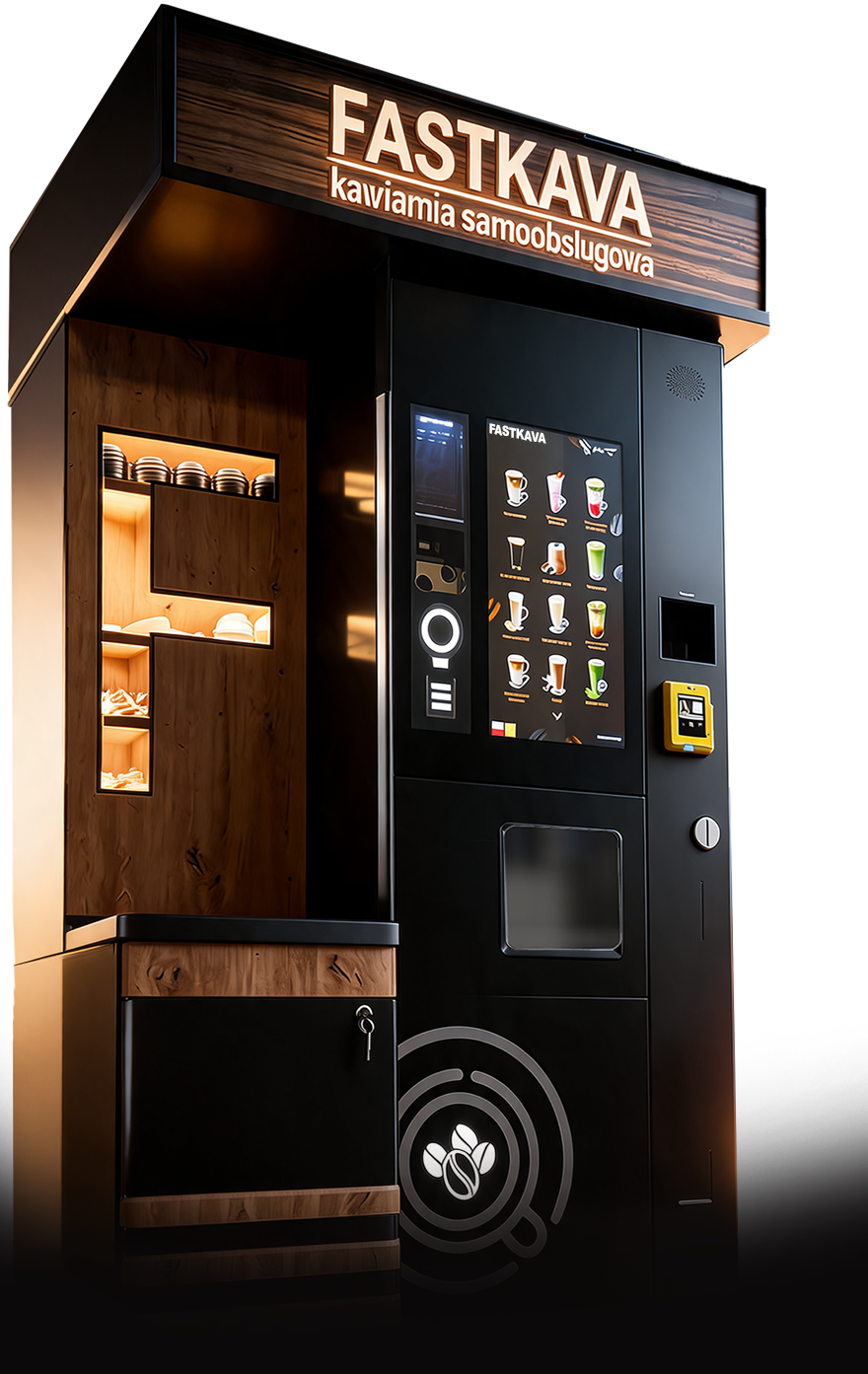
FASTKAVA offers several models across the Standard, Business and Premium lines, so the configuration can be matched both to the character of the location and to the budget. It’s worth making the model choice together with the menu decision — a point aimed at quick coffee for work has different requirements than one meant to be a “drinks hub” at a gym or university.
Step 3. Find a location and sign a contract
This is the most important decision in the whole process — more important than choosing the model. The same machine in a high-footfall spot can sell many times more than in a random one. Look for a location with high, repeatable foot traffic:
- office buildings and business centres,
- gyms and fitness clubs,
- universities and higher or post-secondary colleges,
- clinics, hospitals and government offices,
- stations, petrol stations and shopping malls,
- hotels, as well as production plants and logistics centres.
With the owner or manager of the building you sign a contract to place the machine — most often this is a monthly rent for the occupied space or a commission model based on turnover. Before signing, assess the real footfall: how many people pass by during the day and at what times, what their profile is (workers, students, athletes) and whether there’s competition nearby. We write about choosing a spot in detail in a separate article on locations.
Step 4. Handle the formalities
In Poland, running such an activity usually starts with registering a sole proprietorship (jednoosobowa działalność gospodarcza) or another legal form. Depending on the scale and situation you register for VAT, and since you sell drinks intended for consumption, you must meet basic sanitary requirements. The scope of obligations depends on the form of activity and the scale — it’s best to confirm the details with an accountant.
If you’re from abroad and considering business in Poland, additionally check questions of business registration and tax accounting with an adviser. In practice the self-service model is one of the simpler forms of activity — you don’t run a food outlet with a full kitchen, which simplifies part of the formalities.
This is a general description, not legal or tax advice. Confirm the scope of formalities and sanitary requirements with an accountant or adviser before you start.
Step 5. Delivery, installation and launch
After choosing the model and location, the device is delivered and started up. In the turnkey model this includes configuring the menu, setting up the payment system (including cashless payments) and the first stocking at the client’s cost. From that moment the machine is ready to sell — no renovation, no premises fit-out, no recruitment. It’s this stage that best shows how much the self-service model shortens the path from decision to a working business.
Step 6. Set up the menu and prices
Match the drinks to the location and set prices with an appropriate margin. Remember the premium items — matcha, protein shake, milkshake — which raise the average receipt while ingredient cost stays low. Also take care of seasonality: in summer showcase cold drinks and lemonades, in winter hot chocolate and coffee.
A simple rule proves itself: the coffee core everywhere, accents for the audience. At an office building, bet on a strong coffee offer with matcha added; at a gym, put protein shakes and matcha front and centre; at a post-secondary college or a mall — milkshake, lemonades and flavoured drinks. The menu doesn’t have to be maximal right away — it’s better to start with a proven set and tune it based on real sales data.
Step 7. Local marketing and the first weeks
At the start, simple local action gives the most. Take care of clear signage to the point and the machine’s visibility in the building. Consider a first-drink promo or a launch discount to encourage the first purchase and build a habit. It’s also worth ensuring presence on maps and in the communications of the building where the machine stands (e.g. a notice for office-building workers or fitness-club members).
The first weeks are also a time for observation: which drinks sell best, at what times footfall is highest, what’s missing. On this basis you tune the menu and prices — and that’s a normal part of launching a point, not a sign of a mistake.
Step 8. Upkeep, servicing and scaling
Ongoing upkeep comes down to refilling ingredients and basic device hygiene. In the turnkey model, deliveries and servicing support you, so the point doesn’t require the owner’s daily presence — this is exactly what makes this business largely passive.
Once the first machine works stably, scaling is the natural step. Adding further devices in proven locations doesn’t require proportionally more work, because the same back office serves many points. This way a network is built from a single self-service café.
How much it costs to open a self-service café
The biggest item is the machine itself. At FASTKAVA, entering a turnkey self-service café starts roughly from about €6,000, and the exact sum depends on the model and menu configuration. On top of this come small start-up costs: the first stocking and any rent for the space paid up front.
The good news is that the device doesn’t have to be bought for cash — FASTKAVA offers instalments and leasing, so the entry threshold is lower and the point can earn while it’s still being paid off. We break down the price and payback period in detail in a separate article on the machine’s cost.
How long it takes to open a point
Compared with classic food service, the process is short. Choosing a model and initial talks about a location are usually a matter of a few to a dozen-odd days. Negotiating the space contract and registration formalities depend on your readiness and can take from a few days to a few weeks. The delivery, installation and start-up of the machine itself is most often a single day. In practice, only a few weeks can pass from decision to first sale — with no renovation and no team-building.
The most common mistakes at the start
- Hasty location choice — going by low rent instead of real foot traffic.
- Too narrow a menu — limiting yourself to coffee and skipping matcha, milkshakes or protein shakes, which broaden the customer base and raise the receipt.
- Poor prices — premium items priced too low, giving away margin needlessly.
- No seasonal tuning — not showcasing cold drinks and lemonades in summer, and hot chocolate in winter.
- Neglected hygiene and stocking — even the best location won’t forgive an empty or dirty machine.
Pre-launch checklist
Before you launch the first point, make sure you’ve ticked off the most important things:
- A chosen target audience and an initial menu plan matched to it (with premium items: matcha, protein, milkshake).
- A machine model chosen for the character of the location and the budget.
- A verified location with real foot traffic and a signed space contract.
- Formalities handled (business, VAT if applicable, sanitary requirements) — confirmed with an accountant.
- A decided financing method for the device (cash, instalments or leasing).
- A first-stocking plan and a price list with an appropriate margin.
Frequently asked questions
Do I need premises?
No. A self-service machine is placed on rented space in an existing building — an office block, a gym, a station. This removes the cost and formalities of running a food outlet.
Do I have to know about coffee?
You don’t have to be a barista. Drink quality is ensured by the device and the recipes, and implementation is on the supplier’s side. Your role is running the business — choosing the location, menu and prices — not brewing coffee by hand.
Can I open a point as a foreigner?
Yes, running such a business in Poland is possible for people from abroad too. Questions of business registration and accounting are worth confirming with an adviser. It’s one of the simpler ways to enter the Polish market, without having to open a full-fledged outlet.
How many machines is it worth having to start?
It’s best to start with one and treat it as a test of the model in practice. Once the point works stably, scaling to further locations is simple, because the back office serves many machines simultaneously.
Is a franchise better than an independent start?
The franchise model shortens the path at the start: you get a proven configuration, support in choosing a location, deliveries and servicing. For someone without experience in this business, it’s usually a faster and safer path than building everything from scratch.
Ready to start? Get to know the FASTKAVA franchise model and the available machine models and choose a configuration for your first location. If you want to estimate profitability first, take a look at the article on passive income and the costs of launching a point.