Passive income in Poland: how much you’ll really earn from a self-service café
CONTENTS
“Passive income” is today one of the most sought-after financial solutions. More and more people with capital set aside want it to work for them rather than sit in an account and lose value to inflation — and they’re looking for a concrete business idea or a way to invest their money. The problem is that most “passive” ideas either require a very large outlay (real estate) or come with considerable risk and a lack of control (the stock market, crypto).
A self-service café is a proposition somewhere in the middle: a real, physical business with understandable economics that, once launched, requires little involvement. In this article we show, without beating around the bush, where the profit comes from, how much — roughly — you can earn, how this model compares with other investments and what really determines the payback.
Note: all amounts in this article are illustrative examples meant to show the mechanics of the business. Actual results depend on the location, menu, prices and costs of a given place — they are not a promise or a guarantee of earnings.
Passive income — the promise vs reality
Let’s be honest from the start: completely “hands-off” income practically doesn’t exist. Even renting out a flat requires management, and dividends require choosing companies. So with machines we speak of semi-passive income: once set up and running, the point generates revenue regardless of whether you’re on site, and the ongoing duties are so small and repeatable that they’re easy to delegate.
This is an important distinction, because it guards against disappointment. We’re not selling a “set up a machine and forget it” vision. We’re selling a model in which the owner’s work is reduced to a minimum, and most of the absorbing tasks — deliveries, servicing, sales monitoring — are taken over by the back office. In practice that means a quarter of an hour at the point every now and then, not a full-time job.
What a self-service machine business is
The model is simple and therefore effective. You place a machine in a busy spot that independently sells drinks 24 hours a day, 7 days a week. You don’t employ a barista, you don’t pay for shifts, you don’t draw up rotas, you don’t worry about absences. The customer selects a drink on the screen and pays, and the device prepares it in a few dozen seconds. Your job is to make sure the machine has ingredients and runs smoothly — the rest is done by the location and the menu.
This is a fundamental difference from classic food service, where the biggest cost and biggest headache is usually staff. Here the “employee” is a device that doesn’t fall ill, doesn’t take holidays and works at night too.
Where the profit really comes from
The source of profit is the margin on a single drink — the difference between the price the customer pays and the cost of the ingredients needed to prepare it. In machine drinks this margin is high, because the cost of coffee, milk, syrup or matcha per cup is small relative to the sale price.
But something else is crucial: the menu structure. Premium drinks — matcha latte, protein shake, milkshake — let you price a cup higher than a plain americano, while ingredient cost stays low. That means two machines with identical footfall can have completely different results simply because one sells coffee alone while the other has higher-receipt items on offer. A broad menu doesn’t just attract more customers — it genuinely raises the average value of every transaction.
How much you can earn — a sample calculation
Let’s work it out on illustrative, cautious figures for a well-chosen location. This isn’t a forecast of your result — it’s a way to show how the numbers add up:
- Average drink price: approx. PLN 8.5.
- Average ingredient cost per drink: approx. PLN 2–3.
- Gross margin per drink: approx. PLN 5–6.
- Sales in a good location: 30–60 drinks a day.
- Daily revenue: approx. PLN 300–600.
- Gross margin per day: approx. PLN 200–450.
- Gross margin per month: roughly PLN 6,000–9,000.
From this gross margin you still have to subtract fixed costs: rent for the machine’s space (often a few hundred zloty a month), electricity, servicing, a possible instalment or lease payment on the device, and taxes. Once these are accounted for, the owner’s net profit remains. So even after costs, we’re talking about a sensible, repeatable income from a single point — and the greatest potential emerges with scaling, which we’ll cover shortly.
Note one thing: these figures grow fastest not by cutting costs but by lifting the top of the equation — more customers and a higher receipt. That’s why location and the menu (including premium drinks) matter more than anything else.
What determines your result
Two identical machines can produce wildly different results. Several factors decide it:
- Location. Foot traffic is the fuel of this business. The same machine in an office building and on a side street will give results that differ many times over. It’s the most important decision in the whole venture.
- Menu. A point with matcha, a protein shake and a milkshake sells more and at higher prices than a “coffee-only” machine. A broader menu = more customers from the same footfall and a higher average receipt.
- Operating hours. 24/7 availability captures footfall in the evening and at night too — at stations, round-the-clock gyms, hotels or shift-based workplaces, this is a real part of turnover.
- Prices and positioning. Premium drinks let you hold a higher margin without scaring customers off, provided they’re well matched to the place.
- Seasonal tuning. In summer you showcase cold drinks and lemonades; in winter, hot chocolate and coffee. Thanks to this, revenue doesn’t collapse out of season.
“Passive” in practice — what the turnkey model does for you
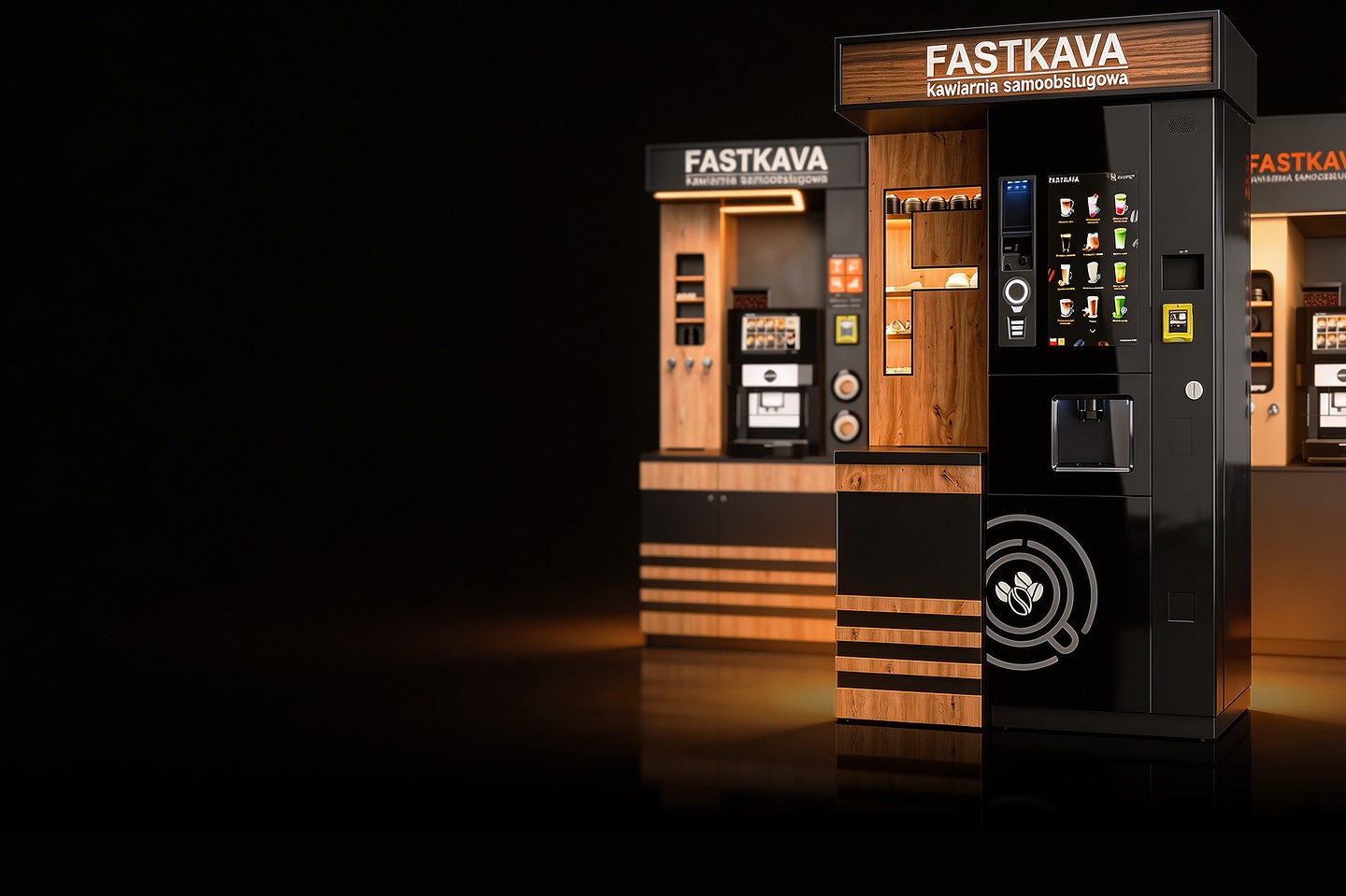
The machine itself is only half the story. In the FASTKAVA turnkey model you get a back office that takes over the most time-consuming tasks and makes the income genuinely largely passive:
- Ingredient deliveries — you don’t organise the logistics of coffee, milk, matcha or syrups yourself.
- Technical servicing — keeping the device in working order doesn’t fall solely on you, and downtime without servicing is the most costly thing in this business.
- Monitoring and CRM — you have insight into sales and stock levels, so you manage the point remotely and know when to restock.
- Support in choosing a location — a good spot is the basis of the payback, so you’re not left alone with that decision.
Thanks to this, ongoing upkeep comes down to refilling ingredients and basic device hygiene — tasks you can easily hand off to someone.
Passive income from a machine vs other forms of investing
People asking “where to invest my money” usually compare several options. Let’s line them up honestly:
- A bank deposit — safe, but in real terms barely protects capital against inflation. Minimal return.
- Rental property — solid, but requires a large outlay (often several hundred thousand zloty), and the rate of return is counted in years, not months.
- The stock market and cryptocurrencies — can give more, but with significant risk, volatility and no real control over the result.
- A self-service café — a relatively low entry threshold, a short payback period and a real business you have influence over: you choose the location, menu and prices.
This doesn’t mean a machine is “better” than every alternative in every situation. It means that for a sum on the order of a few tens of thousands of zloty it offers one of the most favourable ratios of return to involvement — with a shorter horizon than property and less risk than financial markets.
Scaling: from one machine to a network
The greatest strength of this model only emerges with scaling. Treat the first machine as a test: you learn location, menu and price selection on real data. Once the point works, adding a second and third device doesn’t require proportionally more work — the same back office (deliveries, servicing, monitoring) serves many points at once.
- Stage 1 — one machine: learning the model, optimising location, menu and prices.
- Stage 2 — two or three machines: you repeat what worked in further proven spots.
- Stage 3 — a network: a shared back office serves many points; income scales faster than the demand on your time.
This way “extra income” turns into a real business, and passive income stops being a slogan and becomes a repeatable mechanism.
Let’s show it illustratively. If one well-placed machine yields, say, a few thousand zloty of net profit a month, then three such points — served by the same back office — multiply that result nearly threefold, with only slightly more work for the owner. That’s exactly why people who take this business seriously rarely stay with a single machine: real passive income is built on several points at once.
Risks — honestly, and how to limit them
No business is free of risk, and it’s worth saying so plainly. The most common threats are: a poor location (low footfall despite attractive rent), technical downtime without responsive servicing, and poorly chosen prices or too narrow a menu, which lower the margin. The good news is that each of these risks can be limited:
- Location risk — through an honest assessment of foot traffic before signing a contract and support in choosing a spot.
- Downtime risk — through a model with servicing and deliveries that minimises fault time.
- Low-margin risk — through a broad menu (matcha, protein, milkshake, lemonades) that spreads demand across many drinks and seasons and lifts the receipt.
In other words, diversifying the offer — not “coffee only” — is one of the most important safeguards of this business. The broader and better-matched the menu, the more stable and secure the revenue.
The most common mistakes that reduce passive income
It happens that the same model earns brilliantly for one person and barely breaks even for another. Usually the same mistakes are to blame:
- Choosing a location “for the rent”, not for the footfall. A cheap spot without people is more expensive than a good spot with higher rent, because it doesn’t sell.
- Narrowing the menu to coffee alone. Giving up matcha, milkshakes or protein shakes is a voluntary loss of part of your customers and a lower receipt.
- No seasonal tuning. In summer, cold drinks and lemonades must be front of mind; in winter, hot ones. A “one-weather” machine loses half the year.
- Premium items priced too low. Matcha or a protein shake sold too cheaply gives away margin for no reason.
- Neglecting the point. An empty or dirty machine puts people off even in the best location — basic hygiene and regular stocking are a condition of the payback.
The good news: all these mistakes are entirely within your control, and the turnkey model — with location selection, deliveries and monitoring — helps you avoid most of them.
Frequently asked questions
How much do you need to invest to start?
Entering a turnkey self-service café starts roughly from about €6,000 and covers the device and implementation support. The exact cost depends on the model and configuration — we write about this in more detail in a separate article on the machine’s price and payback period.
Is it really passive income?
In practice it’s semi-passive income: once launched, the point requires small, repeatable involvement (refilling ingredients, hygiene) that is easy to delegate. Deliveries, servicing and monitoring in the turnkey model take the most time-consuming duties off the owner.
How long until the machine pays for itself?
It depends on the location, menu and prices, but with a well-chosen point the payback period usually falls in the range of a few to a dozen-odd months — shorter than in classic food service. We break this down in detail in the article on costs and payback.
Do I need experience in food service?
No. Drink quality is ensured by the device and the recipes, and implementation and the back office are on the supplier’s side. Your role is running the business and choosing the location — not brewing coffee by hand.
Can I run such a business as a foreigner?
Yes, running a point in Poland is possible for people from abroad too. Questions of business registration and accounting are worth confirming with an accountant or adviser — it’s one of the simpler ways to enter the Polish market.
Want to calculate the potential for a specific location? See the passive-income page and the available FASTKAVA machine models, then get in touch for an individual calculation tailored to your place and budget.